
GlobalProtect unleashed chaos

Can you imagine receiving a perfect bill from your electric company that it never actually issued?
That is exactly what happened between April and September 2026.
The attackers stole real customer data and used it to craft personalized invoices sent to individuals who had no reason whatsoever to be suspicious.
The operation combined a flaw in corporate VPNs with mass SQL injections, turning real debtor records into ammunition for an industrial-scale fraud campaign.
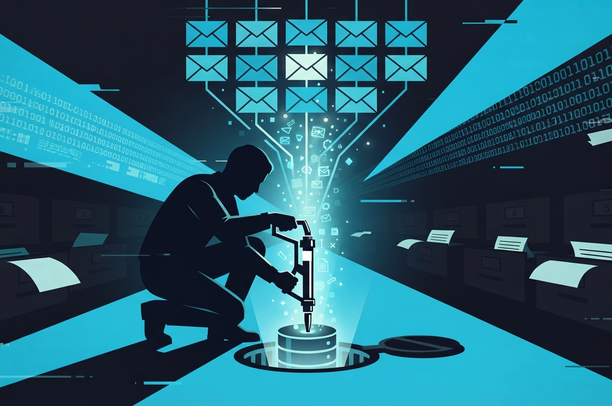
This is how a breach became a fraud factory.
SOCRadar researchers traced the operation, dubbed Operation Master, back to attacker-controlled servers. The entry point was CVE-2026-0257, a flaw in GlobalProtect that allowed VPN sessions to be created without valid credentials. The attackers scanned hundreds of millions of addresses, filtered out vulnerable gateways, and subjected them to an automated exploit loop, achieving confirmed access to seven gateways across four countries.
But getting in was only the beginning of the plan.
Once inside, they launched automated SQL injection attacks against at least nine database systems. On one of the billing servers they executed commands directly against the database and exfiltrated data through DNS requests with an unusual structure. In a single extraction they retrieved 24,558 debtor records. They also used AdaptixC2 to control two compromised Windows servers.
More than 2.4 million fraudulent messages fired off in just a few months.
With the data in hand, the attackers built a fraud panel that changed its appearance to impersonate different utility companies. They used twelve hijacked Microsoft 365 mailboxes and eight SMS gateways. Every message arrived personalized with the customer’s real data, giving any recipient solid grounds to pay without hesitation.

This scheme is not unique to one sector.
Any company with customer databases and recurring billing—from telecommunications to insurance—can become the source of a similar campaign.
Credential-free VPN access combined with automated extraction makes the scale very difficult to stop.
The panel generated 622,666 personalized links and recorded 317,696 clicks; the exposure from fraudulent invoices exceeded 150 million reais.
The infrastructure went down, but the threat did not.
In mid-September the visible infrastructure was taken offline, but researchers could not confirm whether the operation stopped or simply relocated. The already-stolen data continues to circulate, and the affected organizations still do not know with certainty which customers were targeted.
The fraud also came by phone.
In addition to emails and SMS messages with fake invoices, the attackers used device code phishing against corporate accounts and phone calls to obtain verification codes. These techniques are especially dangerous because the victim interacts with a real login screen or receives an apparently legitimate call, making it nearly impossible to distinguish them from an authentic process without prior training.
First they sold the stolen data, then they used it.
Researchers linked the operator to a profile that was selling stolen records from the energy sector on specialized forums. The same organizations appeared listed weeks before their data was loaded into the fraud campaigns. This reveals a double monetization strategy: first sell, then directly use those same records to pursue payments.
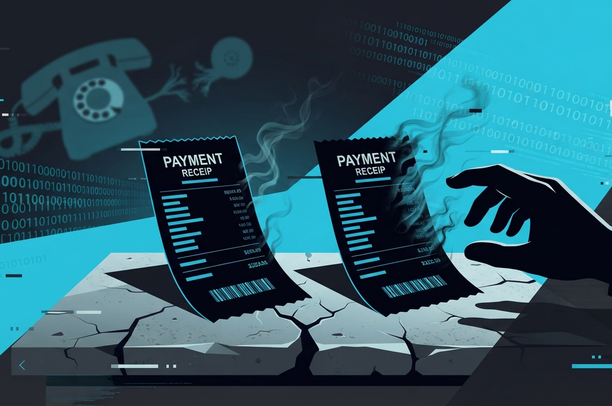
An invoice with your real data is almost impossible to ignore.
Some payment pages displayed the customer’s full name, address, and a visual copy of the original receipt. This eliminates most of the warning signs we would normally detect in a conventional fraud attempt.
How to protect yourself when you receive a suspicious invoice.
Before paying any invoice that arrives by email, SMS, or WhatsApp, verify it directly in your customer portal or call the number you already had saved—not the one shown in the message. If the company billing you has suffered a breach, also notify its customers so they remain alert.
Do not pay without verifying on your own.
The next invoice you receive with all your details correct could be the most dangerous one of all. Would you be able to tell it apart from a real one?
What you can do
- ✓Verify any unexpected invoice through your official account before paying.
- ✓Patch exposed remote access devices and review active VPN sessions.
- ✓Reject unsolicited device code approval requests and enable alerts.
Would you recognize a fake invoice crafted using your own real data?
Security is not improvised, it is audited. At Nacata Security we detect vulnerabilities and protect your company, because a single flaw can cost you everything you have built.
Related articles
Printers distributed ransom notes
Can you imagine arriving at work to find your computer locked with no explanation?

Moucka steals billions
Did you know someone drained one hundred and sixty-five companies from the cloud without raising any suspicion?

The CISO loses total control
Do you think there is someone in complete command of your bank’s cybersecurity?

North Korea Loots Bitget
Did you know an exchange can lose millions in hours without anyone noticing?

Master Prisma SD-WAN with INE
Prisma SD-WAN: From Concepts to Deployment, INE’s new course on enterprise distributed networking.
Nacata Security, reach out to us anytime
We are Nacata Security, get to know us
web: nacata.io
email: info@nacata.io
Phone: 919930793
LinkedIn: Nacata Security
Cyberattacks that have already happened and are confirmed: hacked companies, leaked data, services down after an attack, ransoms paid.
Real cases, with names and clear consequences, explained simply so anyone understands what happened and who it affected.
RATING
8.7
Who are we?
At Nacata Security we are an offensive cybersecurity company specialized in audits and penetration testing.
We detect, assess and help mitigate the vulnerabilities of your systems, networks and applications before a real attacker exploits them, offering 360º defense tailored to each client.
We’d be glad to get in touch with you for whatever you need.